What Will The Next 15 Years Of Power Look Like?
Disclaimer.
This article expresses general analysis for informational and discussion purposes only. The analysis presented is based on publicly available data and forecasts from government agencies and industry sources.
Energy policy, technology costs and regulatory frameworks are subject to change. Readers should conduct independent research and seek professional advice before making business or investment decisions.
This article does not constitute financial, legal, or engineering advice and the views, opinions, thoughts and ideas expressed are those of the author only.
Article Summary.
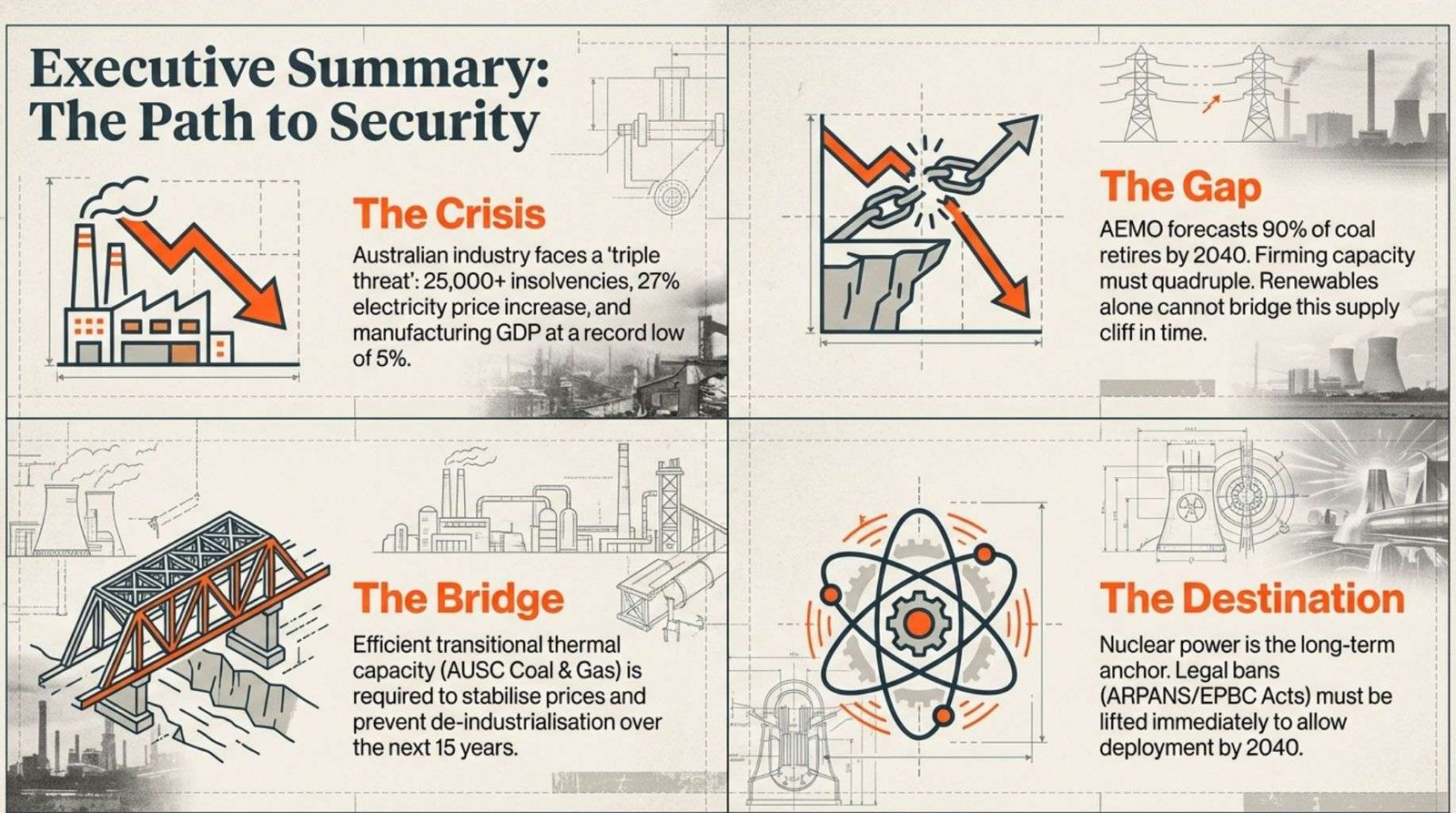
Australia faces a critical 15-year period that will determine whether it rebuilds industrial competitiveness or continues economic decline.
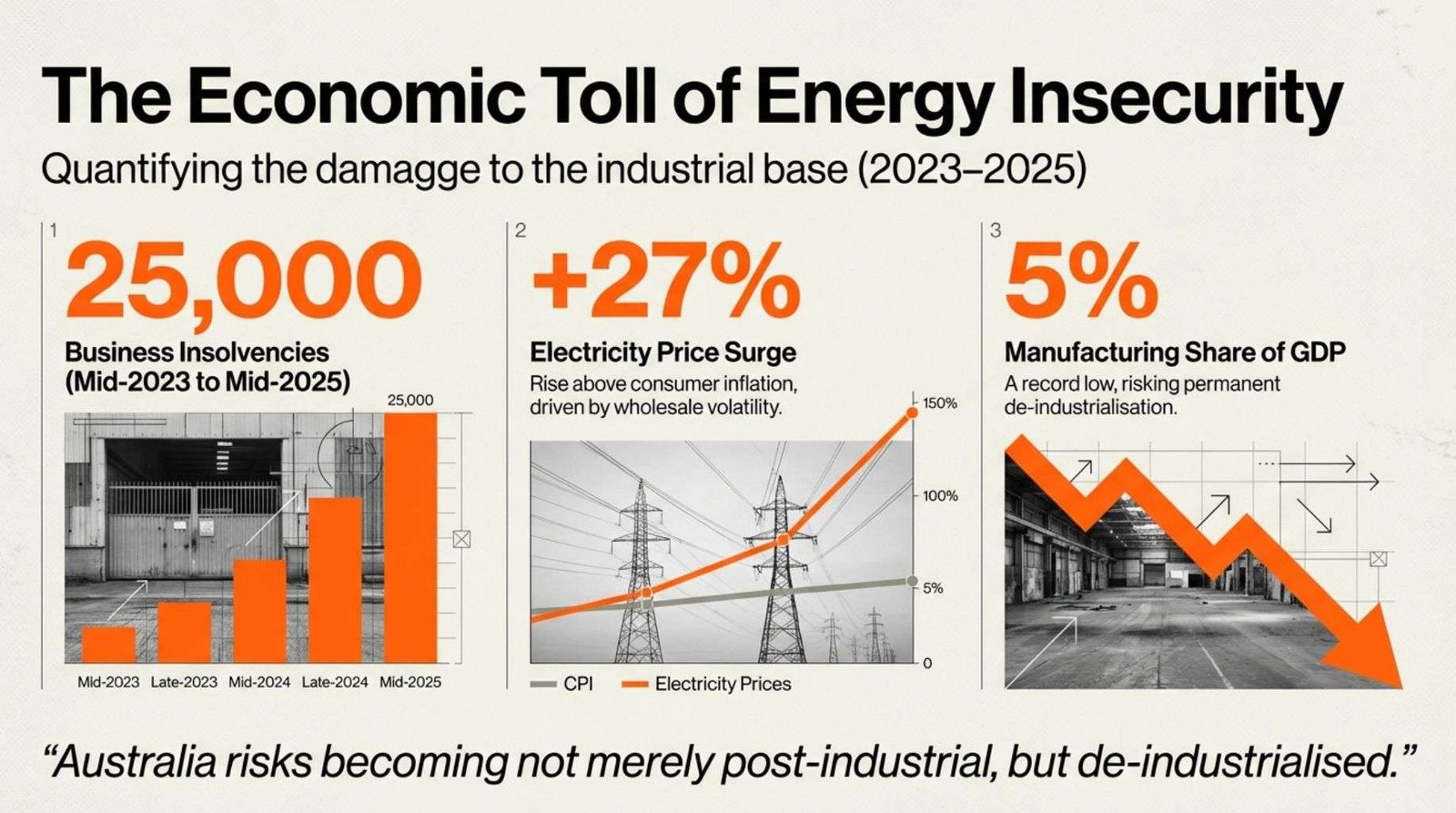
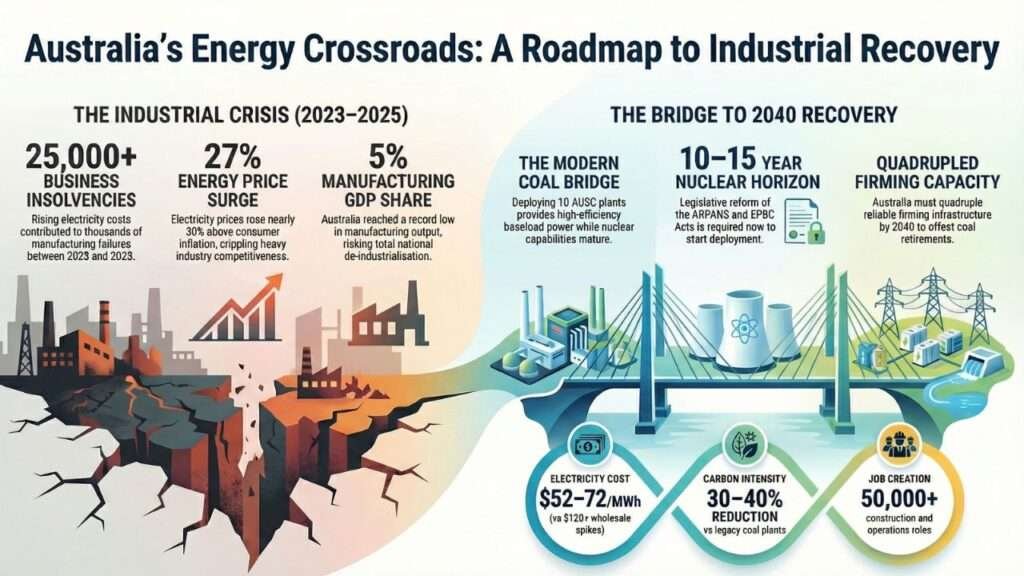
Between mid-2023 and mid-2025, over 25,000 businesses entered insolvency, with electricity prices rising 27% above consumer inflation. Manufacturing’s GDP share dropped to just above 5%, a record low.
Industrial recovery requires stabilising energy prices immediately, strengthening medium-term generation with firm low-emission sources and establishing a credible nuclear pathway.
Without cheap, reliable, round-the-clock electricity, energy-intensive manufacturing, defence production and advanced exports cannot compete globally.
The strategic response involves efficient transitional thermal capacity, quadrupled firming infrastructure by 2040 and a realistic 10-15 year timeline to nuclear deployment.
Top 5 Takeaways.
1. Over 25,000 Australian businesses entered insolvency between mid-2023 and mid-2025, driven partly by electricity prices that surged 27% above consumer inflation.
2. Manufacturing’s GDP share fell to just above 5% by 2025, the lowest on record, risking full de-industrialisation rather than post-industrial transition.
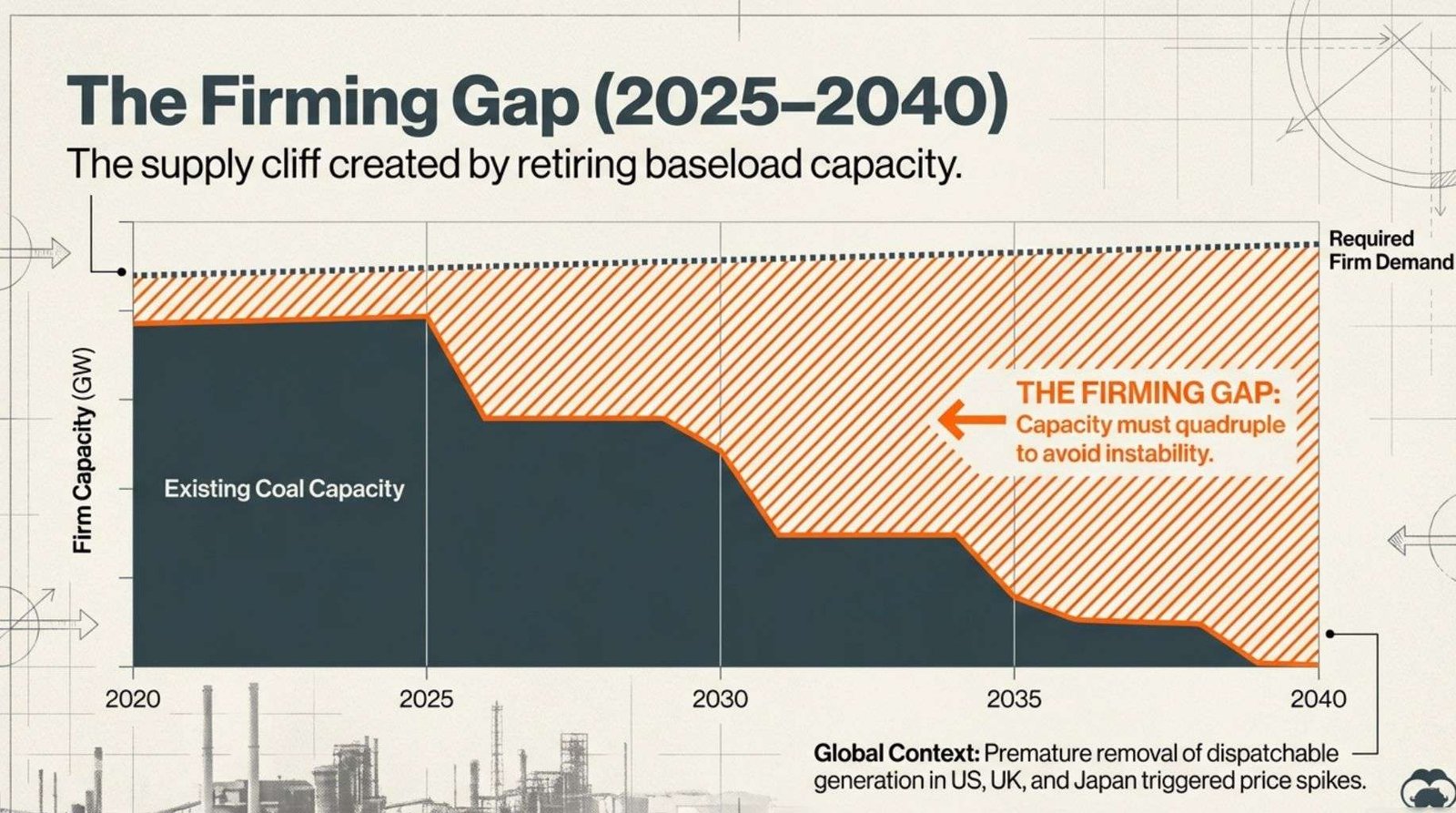
3. AEMO’s 2024 Integrated System Plan identifies that firming capacity must quadruple by 2040 to offset the retirement of 90% of existing coal fleet.
4. Federal legislation (ARPANS Act 1998 and EPBC Act 1999) currently prohibits nuclear power construction, requiring parliamentary amendment plus state-level reforms.
5. Realistic timelines from policy decision to operational nuclear reactor span 10-15 years, meaning delays now extend industrial vulnerability into the 2040s.
Table of Contents.
1. A Nation at an Energy Crossroads.
2. The Case for a Firming Backbone.
3. Bridging to the 2040s: AUSC, HELE and Gas.
4. The Long Road to a Nuclear Option.
5. Building the Institutional Framework.
6. The Legal and Political Roadmap.
7. Integrating Economics and Timelines.
8. Global Lessons in Energy Realism.
9. Why Industry Should Care Now.
10. The Political Imperative.
11. Looking Fifteen Years Ahead.
12. Coal Is The Bridge To Nuclear.
12.1. Reliability Boost.
12.2. Cost Stabilisation.
12.3. Emissions Reductions.
12.4. Industrial and Economic Gains.
12.5. Strategic Bridge to Nuclear.
12.6. Risks and Mitigations.
13. Balance: Industry, Environment, Prosperity & The Cost of Living.
14. Conclusion: Choose Building Over Decline.
15. Bibliography.
1. A Nation at an Energy
Crossroads.
Australia’s recent
economic data reveals significant stress. Over 25,000 businesses entered
insolvency between mid-2023 and mid-2025, as confirmed by the Australian
Securities and Investments Commission (ASIC). For thousands of manufacturers,
rising energy prices contributed to business failure.
Electricity prices surged
approximately 27% above consumer inflation across this two-year period, driven
by wholesale market volatility, network constraints and the global energy shock
that forced domestic gas prices upward.
This shock coincided with
record interest rates and high input costs, creating what some economists now
describe as a “triple threat” to Australian industry.
By 2025, manufacturing’s GDP
share reached a record low of just above 5%. Australia risked becoming not
merely post-industrial, but de-industrialised.
Factories curtailed
operations, smelters reduced output and advanced manufacturing projects shifted
offshore.
Discussions about the
country’s energy future concern the economic foundation of the nation itself.
2. The Case for a Firming
Backbone.
Electricity drives every
segment of industrial growth. For heavy industry, firm, dispatchable baseload
power matters most, generation that runs continuously at predictable cost.
Renewable energy can
provide low-cost kilowatt-hours under favourable conditions, but its
intermittency requires balancing through firming technologies such as pumped
hydro, gas turbine systems, compressed air storage, or nuclear power.
In the Australian Energy
Market Operator’s (AEMO) 2024 Integrated System Plan (ISP), firming was
identified as essential for system reliability.
Even under high renewable,
net-zero scenarios, AEMO forecasts that firming capacity from gas, hydro and
storage must roughly quadruple by 2040 to offset the retirement of 90% of the
existing coal fleet.
That transition presents
challenges. The US, UK and Japan have experienced that removing dispatchable
generation faster than firm replacement capacity can trigger instability,
blackouts, or inflationary price spikes.
Australia shows early
symptoms of similar strain. The response requires building a realistic bridge
using high-efficiency coal and gas at appropriate sites, upgraded hydro where
geography allows and a deliberate pivot to nuclear energy as the long-term
anchor.
3. Bridging to the 2040s:
AUSC, HELE and Gas.
Between now and the early
2040s, high-efficiency low-emissions (HELE) coal, advanced ultra-supercritical
(AUSC) systems and open-cycle gas turbines will remain central to ensuring
continuous supply.
These technologies deliver
large-scale firming power at relatively low capital cost and high efficiency.
They also preserve
valuable labour skills, supply chains and grid topology while the next
generation of baseload, particularly nuclear, ramps up.
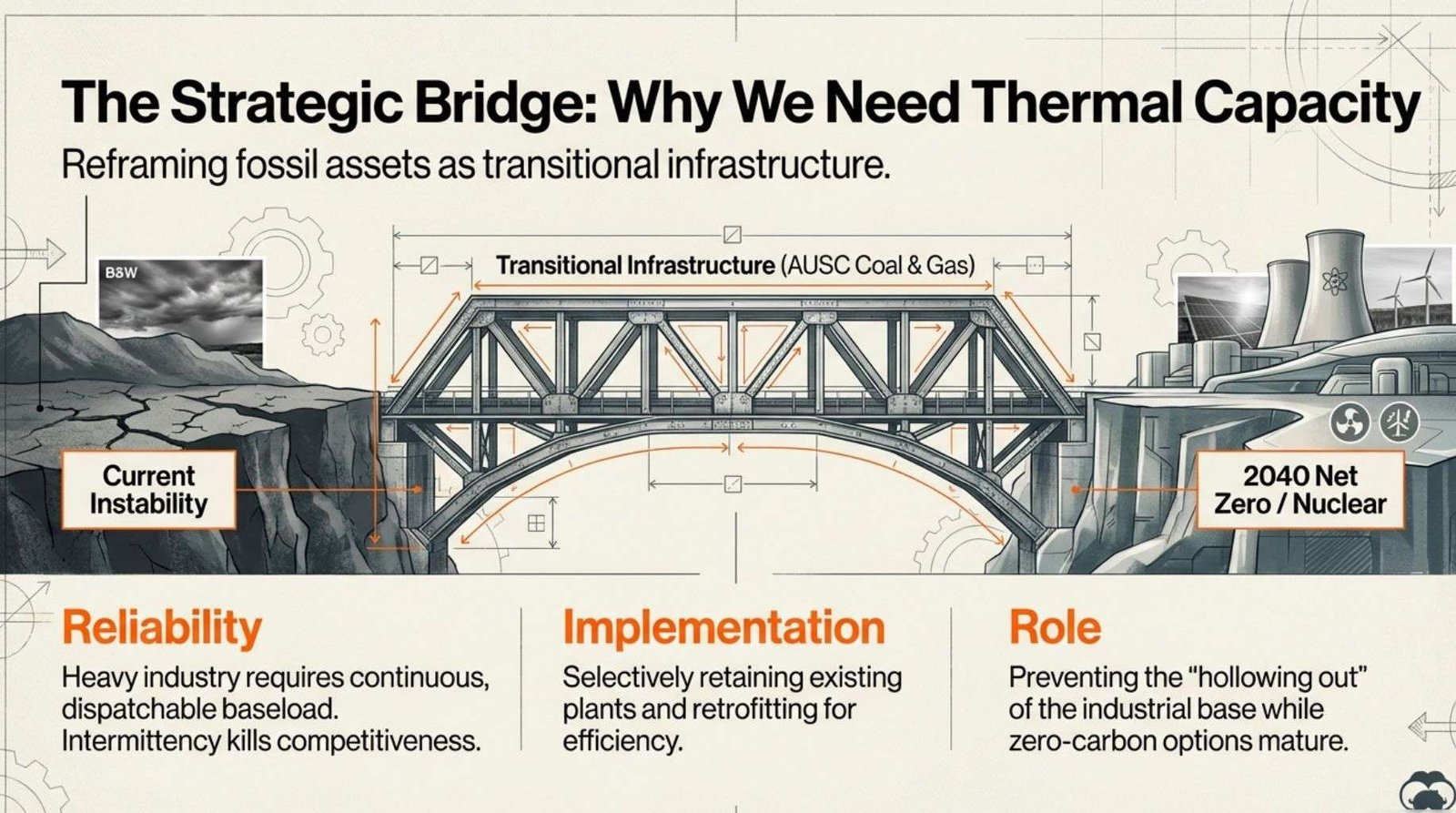
Policymakers should
consider treating modern fossil assets as transitional infrastructure essential
for industrial continuity rather than as competitors to decarbonisation.
The approach requires
appropriate timing and structure. Australia should selectively keep existing
plants online where safe and economic, retrofit them for efficiency or
emissions improvements and concentrate investment in regions already zoned and
grid-connected for heavy generation.
These upgrades act as
insurance, protecting the nation’s manufacturing base while longer-term
zero-carbon options mature.
4. The Long Road to a
Nuclear Option.
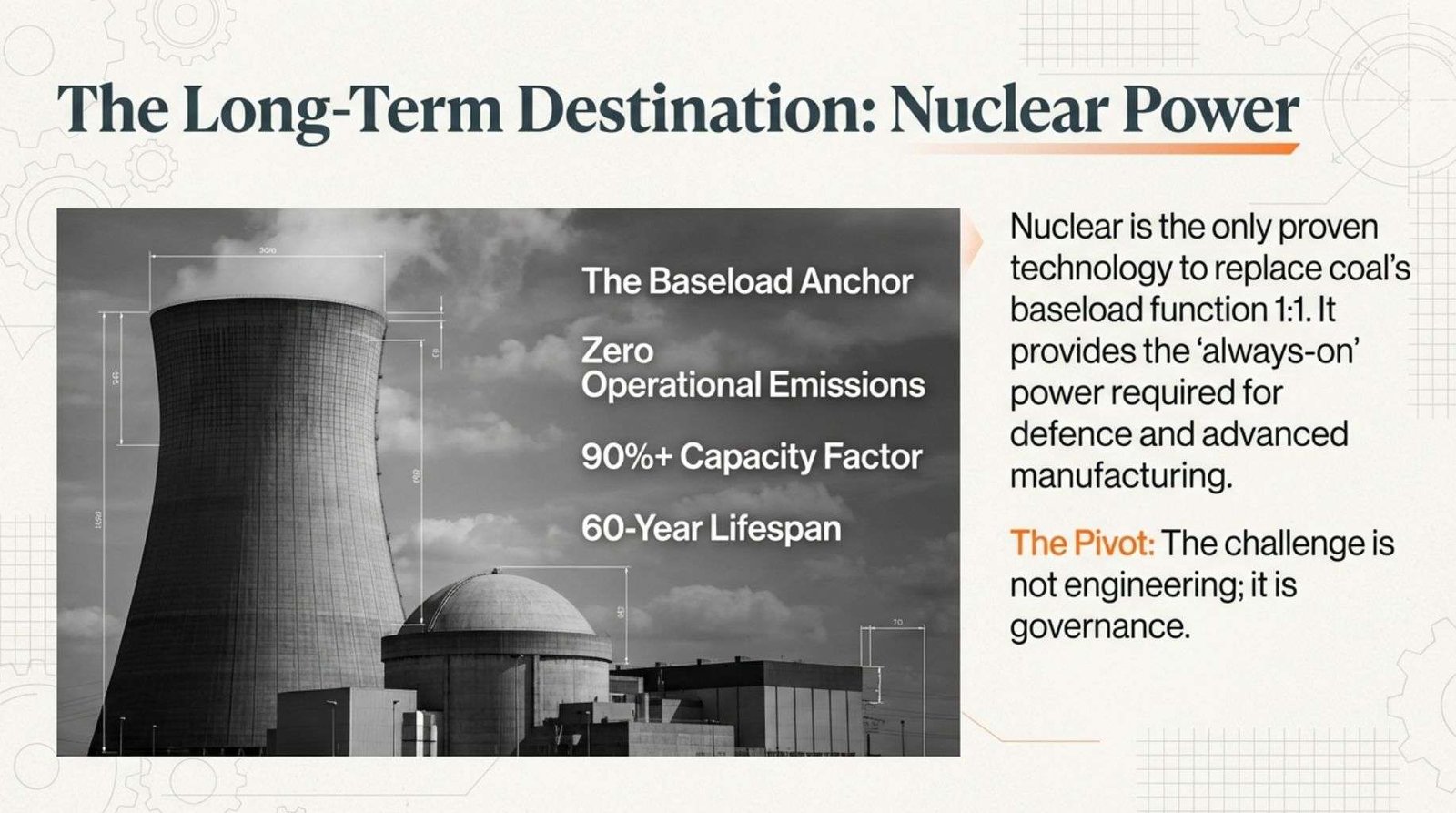
Nuclear power is the only
zero-operational-emission technology currently proven to provide dense,
continuous baseload output.
Its global record, 90%+
capacity factors and multiple 60-year operational lifespans, demonstrates
performance. Deployment in Australia is complicated not by engineering but by
governance, law and time.
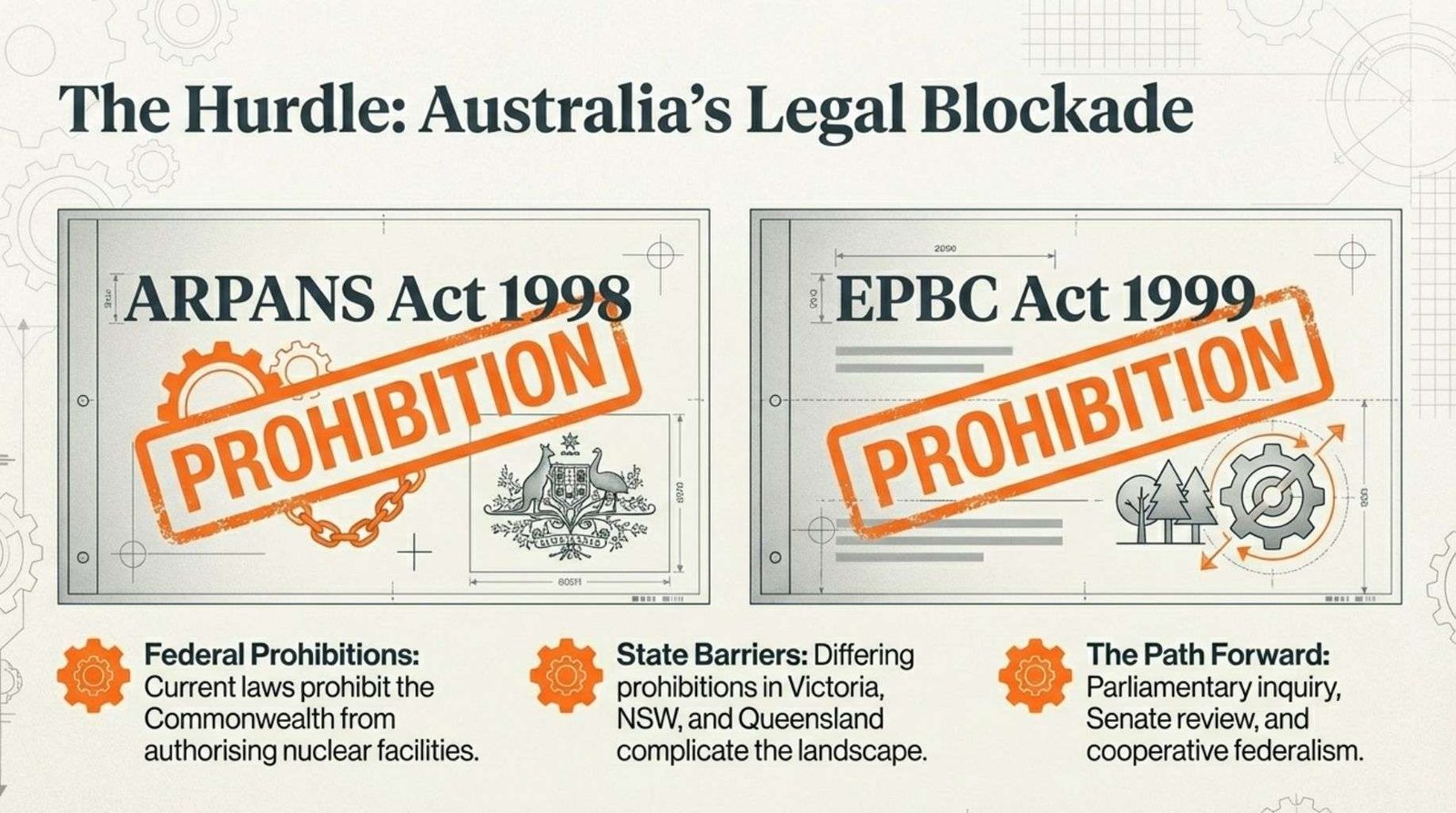
Two pieces of legislation
currently prevent progress:
1.
The Australian Radiation
Protection and Nuclear Safety (ARPANS) Act 1998, which prohibits the
Commonwealth from authorising construction of nuclear power facilities.
2.
The Environment Protection
and Biodiversity Conservation (EPBC) Act 1999, which specifically bans such
facilities under environmental law.
Repealing or amending
these involves parliamentary process, committee review and likely Senate
inquiry. Even if federal bans were lifted, each state would need to modify its
own prohibitions, which differ widely in scope.
Victoria, New South Wales
and Queensland currently legislate against nuclear power plants. South
Australia and Western Australia allow exploration of nuclear minerals but not
generation.
Legislating a path forward
means stepwise negotiation, one jurisdiction at a time, often tied to local
community benefits and regional energy needs. International experience suggests
this process alone can consume several years.
5. Building the
Institutional Framework.
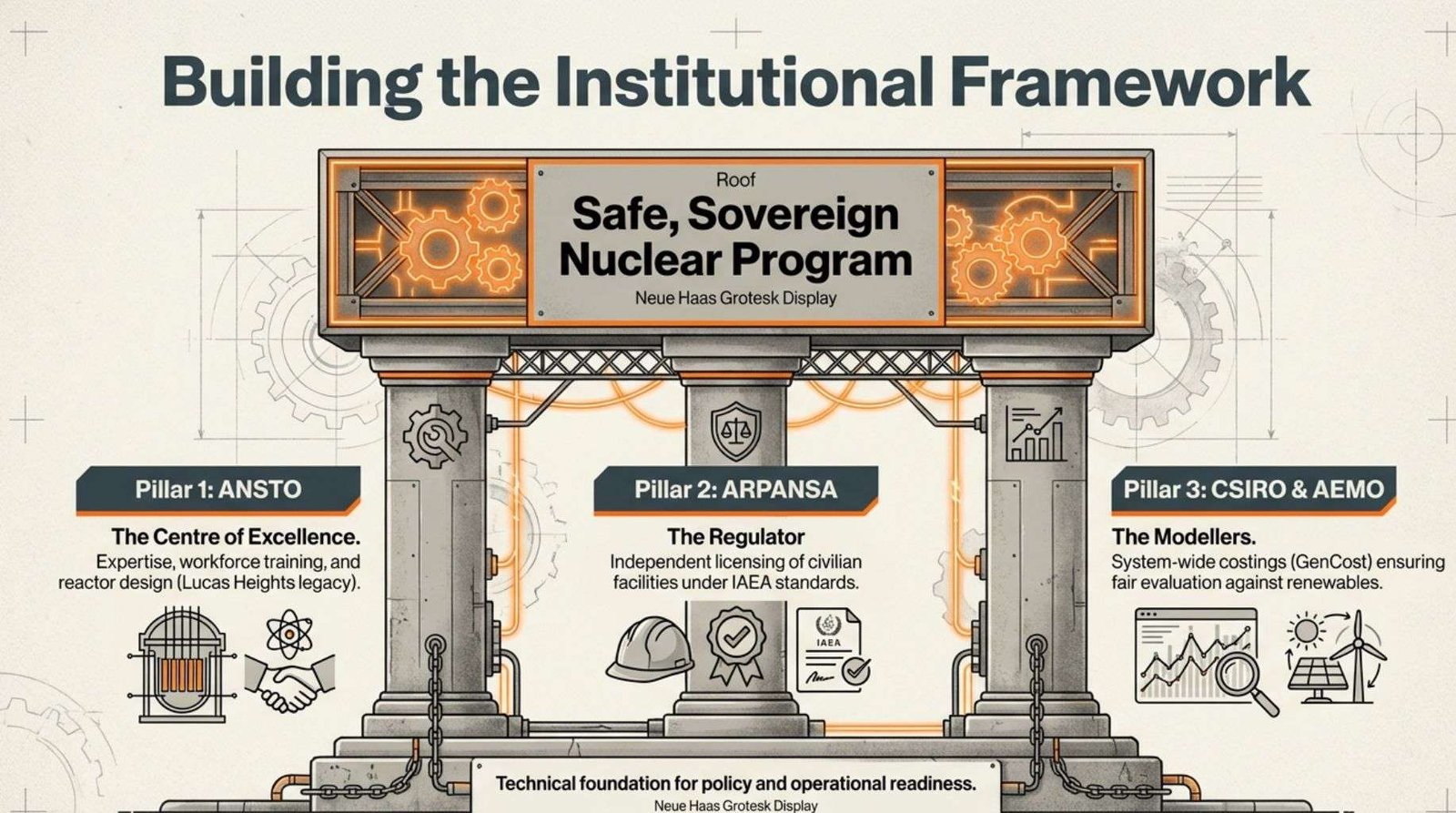
Beyond law, institutional
architecture will define success. The most logical national structure builds
upon Australia’s existing scientific and regulatory pillars:
1.
ANSTO (Australian Nuclear
Science and Technology Organisation) should evolve into the government’s
central nuclear centre of excellence, responsible for technical expertise,
reactor design knowledge and workforce training. Its 60 years of safe reactor
operation at Lucas Heights provide a foundation.
2.
ARPANSA
(Australian Radiation Protection and Nuclear Safety Agency) must remain the
independent, internationally aligned safety regulator. Its mission should be
expanded to license civilian nuclear facilities under globally recognised
standards such as those of the International Atomic Energy Agency (IAEA).
3.
CSIRO and AEMO should
lead on system-wide costings and technology modelling. Through tools like
GenCost and the Integrated System Plan, they must ensure that nuclear is
evaluated on the same methodological footing as renewables, coal and gas.
This framework keeps
oversight balanced: ANSTO provides expertise, ARPANSA ensures integrity and
CSIRO and AEMO supply economic evidence.
Any federal government
will surely turn to CSIRO for cost comparisons, so nuclear should be integrated
responsibly into modeling rather than excluded.
6. The Legal and Political
Roadmap.
The realistic pathway
follows this sequence:
1. Launch an Expert Review involving ANSTO, ARPANSA, CSIRO,
AEMO and major industry partners to map viable reactor types, costs and siting
options.
2. Amend Federal Legislation to remove prohibitions under
the ARPANS and EPBC Acts while ensuring ARPANSA’s authority is preserved.
3. Negotiate with States to modify or repeal state bans
through cooperative federalism, linking each change to potential local sites,
economic benefits and job creation.
4. Advance a First-of-a-Kind (FOAK) Project by selecting a
site with existing heavy industrial infrastructure, for instance, a retiring
coal station and progress through design, licensing, environmental assessment and
financing.
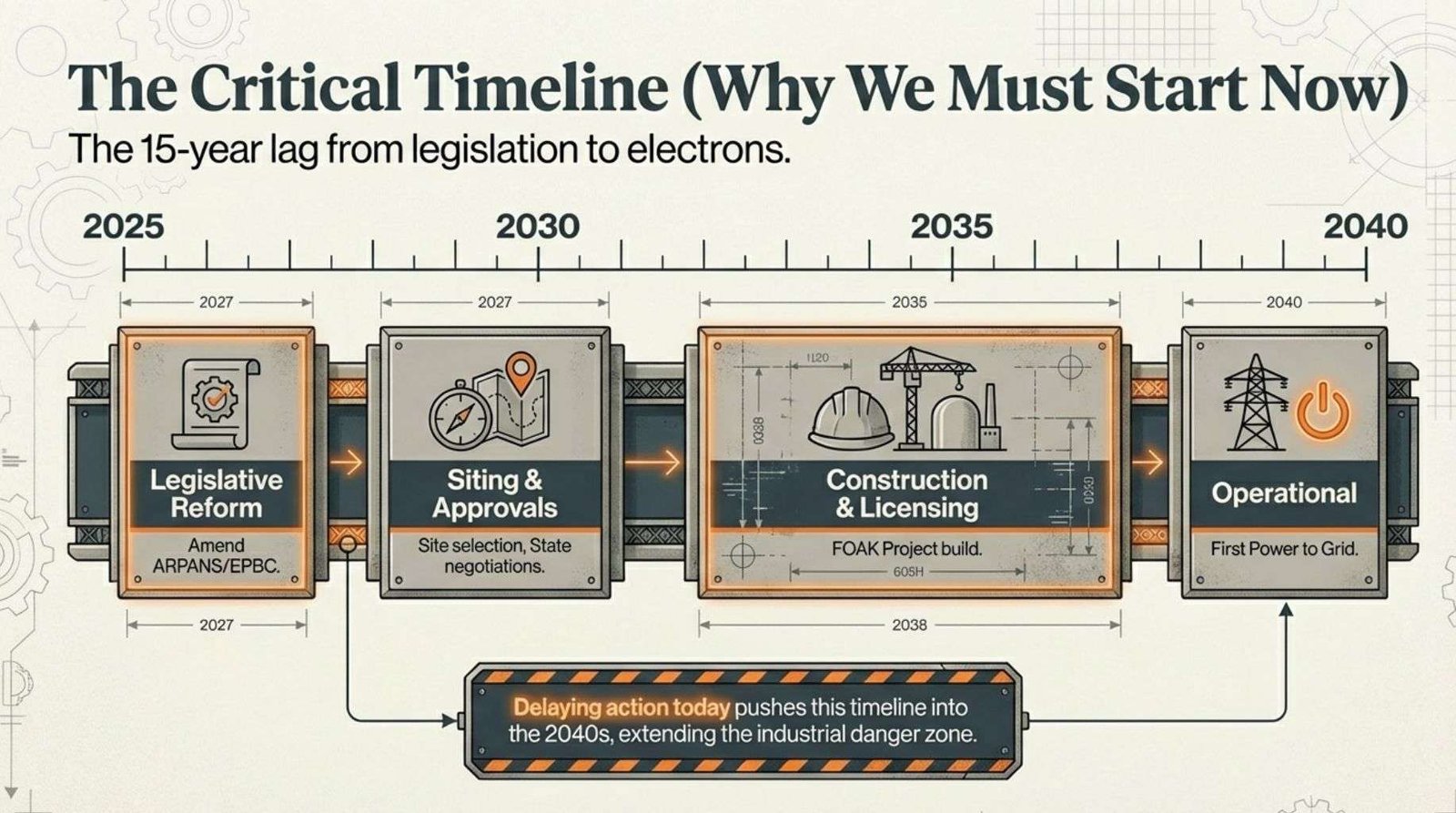
Even with ideal
coordination, the timeline from policy decision to first megawatt-hour of grid
electricity is typically ten to fifteen years.
This aligns with the
experience of nuclear newcomer nations such as Poland and the Czech Republic, which
began their modern programs in the 2020s with first generation expected in the
mid-2030s.
Fleet deployment, the
stage where nuclear meaningfully shifts national cost and emissions profiles, typically
follows another decade later. Delaying the outset of planning makes the task
harder later.
7. Integrating Economics
and Timelines.
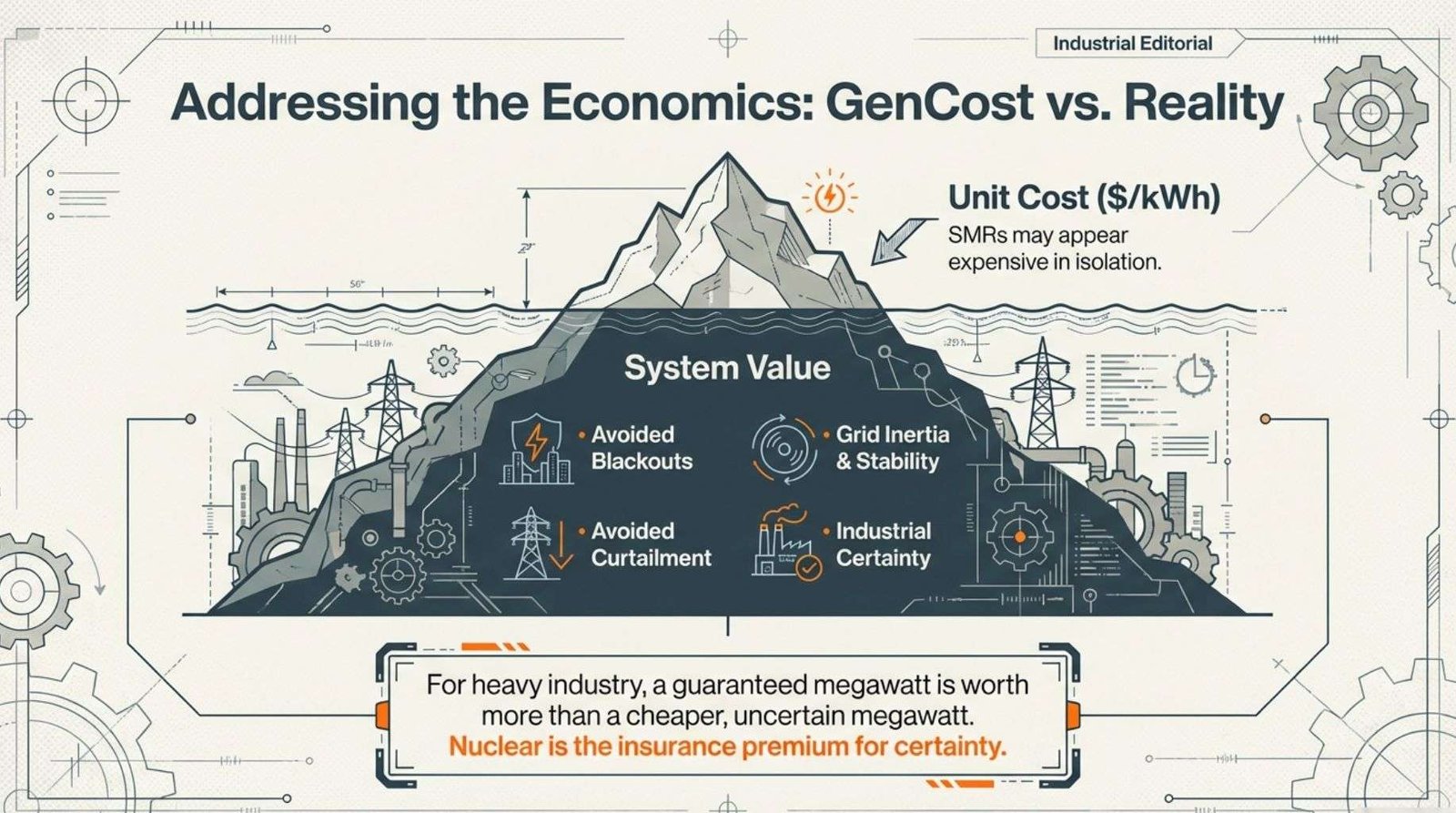
Critics cite CSIRO’s
GenCost analyses to argue that nuclear remains high-cost. In raw dollars per
kilowatt-hour, small modular reactors (SMRs) are currently estimated 40-60% above
renewables with storage.
However, those figures
reflect assumption-heavy early designs without local supply chains or
nuclear-ready regulation. Historically,
unit costs fall steeply once the first plants are built and local capabilities
develop.
System value matters more
than plant-only cost. A grid with intermittent renewables and insufficient
firming experiences high volatility and curtailment, meaning periods of both
surplus and scarcity, each expensive in different ways. Nuclear’s strength
includes not only the energy it generates, but the stabilising effect it exerts
on wholesale prices and industrial certainty.
Industrial investors,
particularly in chemicals, hydrogen and critical minerals processing, value
predictable energy above all.
For them, a megawatt of
guaranteed supply is worth far more than a cheaper megawatt whose availability
is uncertain.
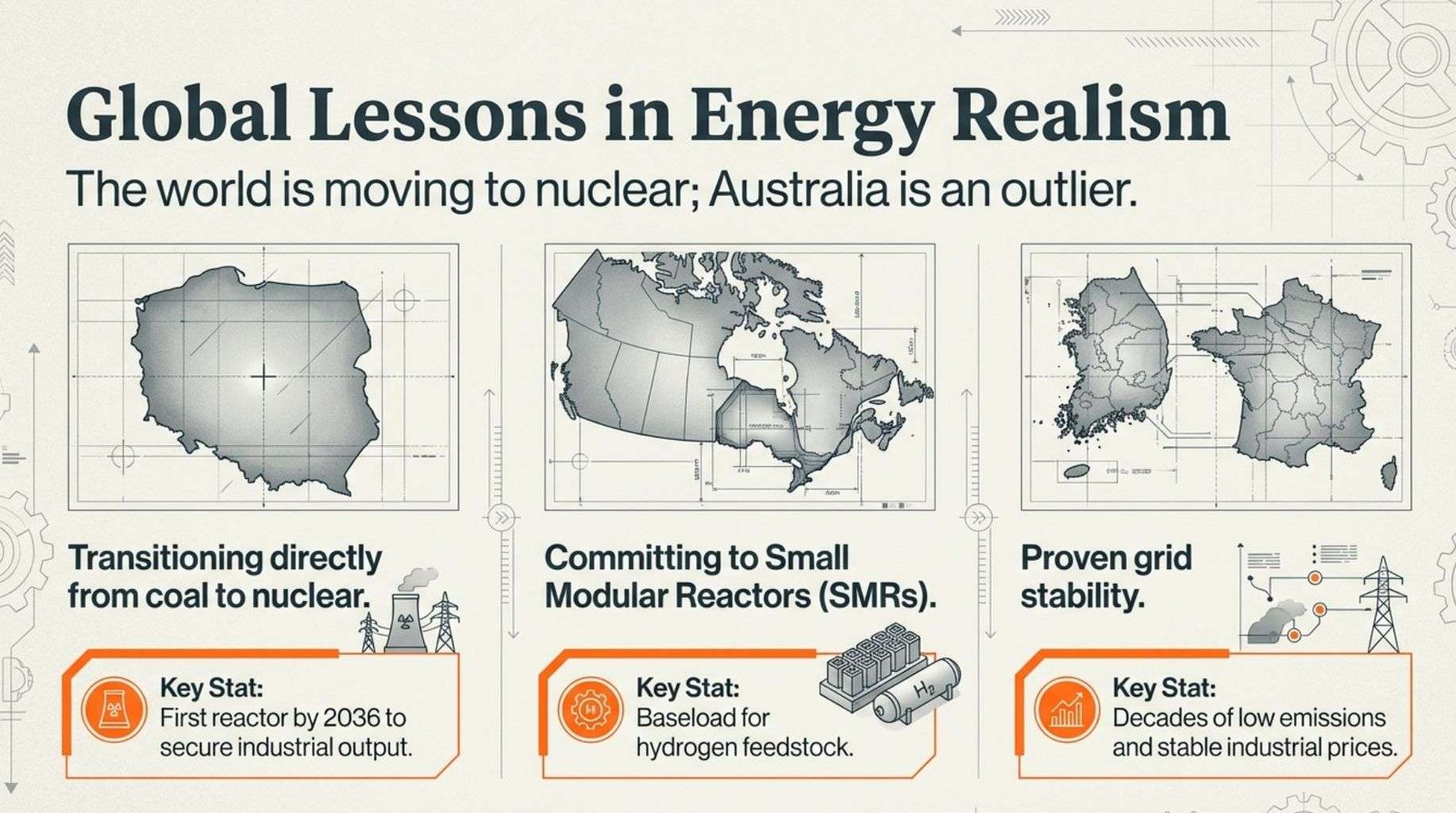
8. Global Lessons in
Energy Realism.
Other developed economies
provide instructive examples:
1.
Poland is transitioning
from coal to nuclear, targeting its first reactor by 2036 and achieving
industrial-scale nuclear output by the mid-2040s.
2.
Canada’s Ontario province
recently committed to multiple small modular reactors (SMRs) as both baseload
and hydrogen feedstock sources, citing round-the-clock energy needs.
3.
South Korea and France
have demonstrated that consistent nuclear programmes stabilise grid emissions
and industrial electricity prices simultaneously over decades.
Australia has spent nearly
25 years officially prohibited from even considering nuclear generation.
That lost time is now
being felt through escalating costs, declining competitiveness and dependence
on imported components for emerging sectors like electric-vehicle batteries and
green hydrogen.
9. Why Industry Should
Care Now.
The argument for nuclear
is industrial rather than ideological.
Without enormous,
continuous electricity at competitive prices, large-scale manufacturing will
remain uneconomic, regardless of tax incentives or sovereign capability
policies.
Energy-intensive industries
such as aluminium, steel, defence manufacturing and data processing require
multi-gigawatt-hour reliability.
Storage and renewables are
improving, but even optimistic projections rely on gigascale battery deployment,
an undertaking that carries its own material and environmental challenges.
Australia’s path forward
is not a binary choice between renewables and nuclear, or between gas and
storage.
It is a sequence:
renewables scale up where economic, transitional thermal capacity maintains
stability and nuclear begins the next era of baseload assurance. In parallel,
demand-side efficiencies and electrification expand but depend on the same
fundamental, abundant, steady energy.
10. The Political
Imperative.
The political challenge
involves sequencing reform while keeping public trust. Nuclear debates can
polarise communities, yet much hesitation stems from outdated imagery rather
than evidence of performance.
Modern reactors are
equipped with passive safety systems, inherently safe designs and multi-layer
containment unmatched in previous generations.
Transparency is essential.
By embedding ANSTO, ARPANSA, CSIRO, AEMO and independent experts in the process
from the outset, Australia can conduct a fact-based conversation grounded in
science, economics and public regulation.
Parliamentary inquiries,
rather than being obstacles, become vehicles to build legitimacy and record the
technical case for future parliaments.
11. Looking Fifteen Years
Ahead.
If serious policy
commitment were made during the current parliamentary term, by 2027, Australia
could feasibly see its first operating reactor around 2038-2040. By then,
almost all coal generation will be retired and reliable clean energy will
define the survival of heavy industry.
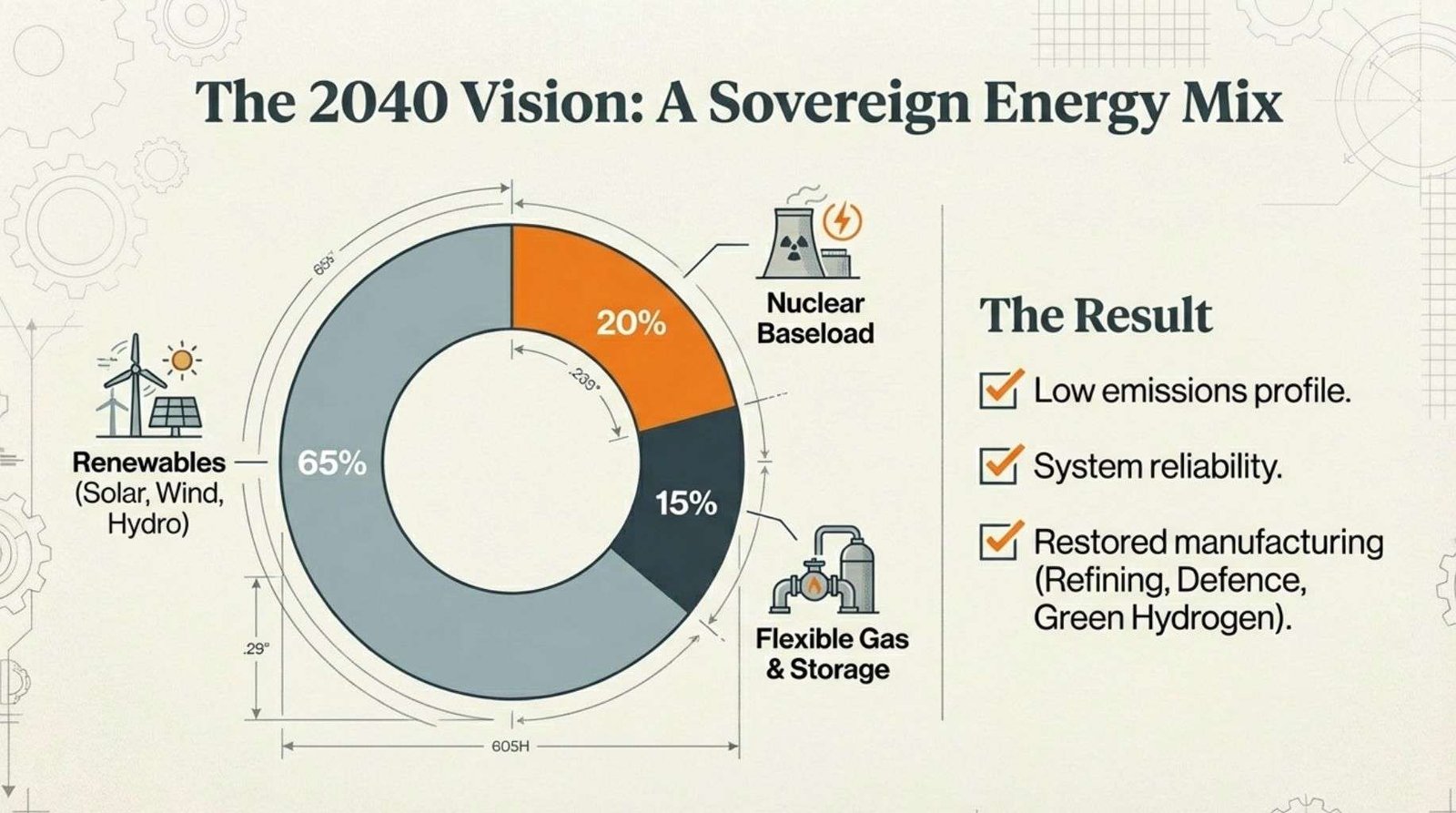
A balanced energy
portfolio in 2040 might include:
- Roughly 60-70% renewables (solar, wind, hydro).
- 10-20% flexible gas and storage.
- 10-20% nuclear baseload.
That mix can deliver both
low emissions and system reliability, anchoring industrial hubs across the east
coast and restoring confidence for long-life investments in refining,
manufacturing and hydrogen production.
12. Coal Is The Bridge To
Nuclear.
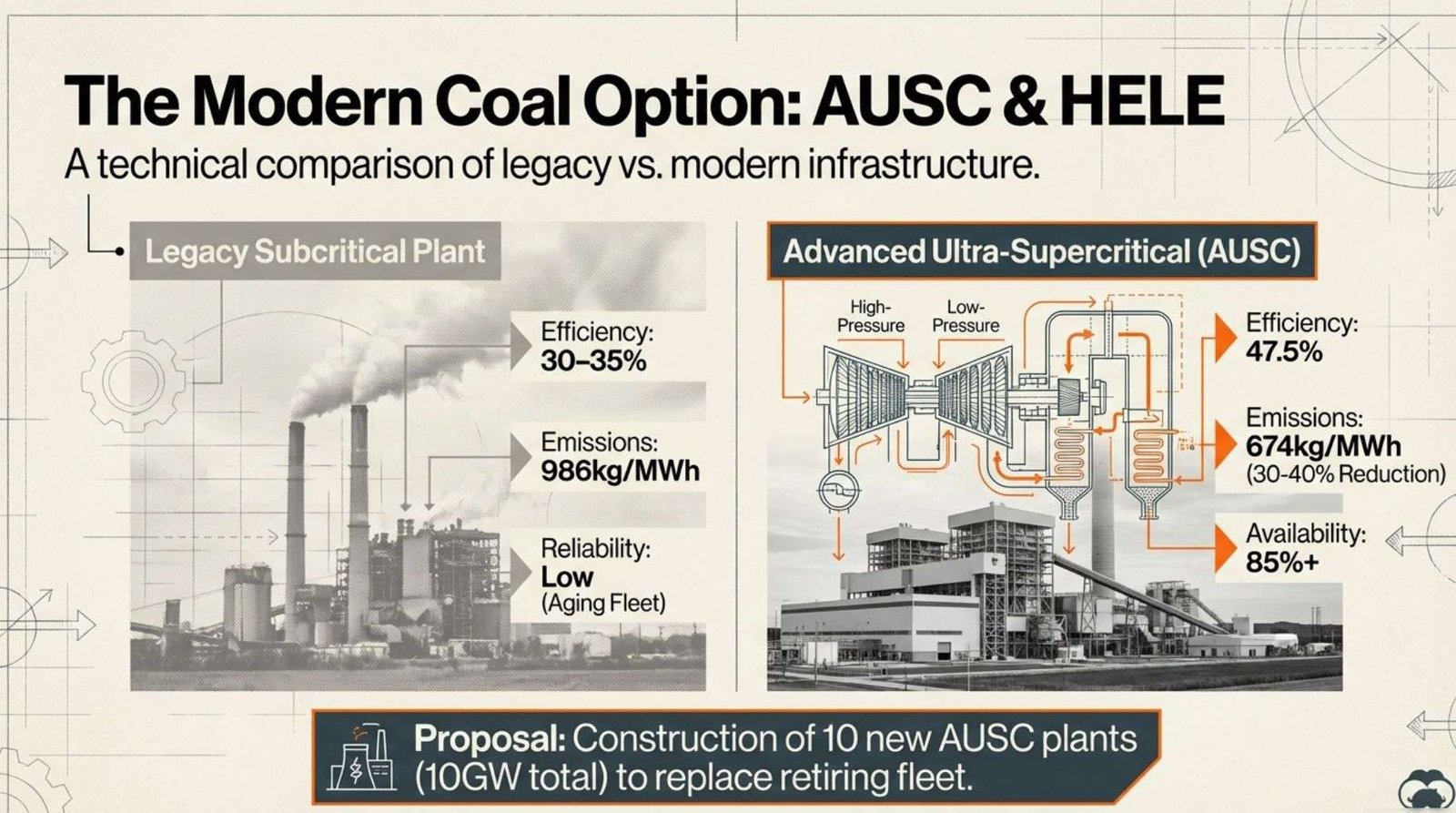
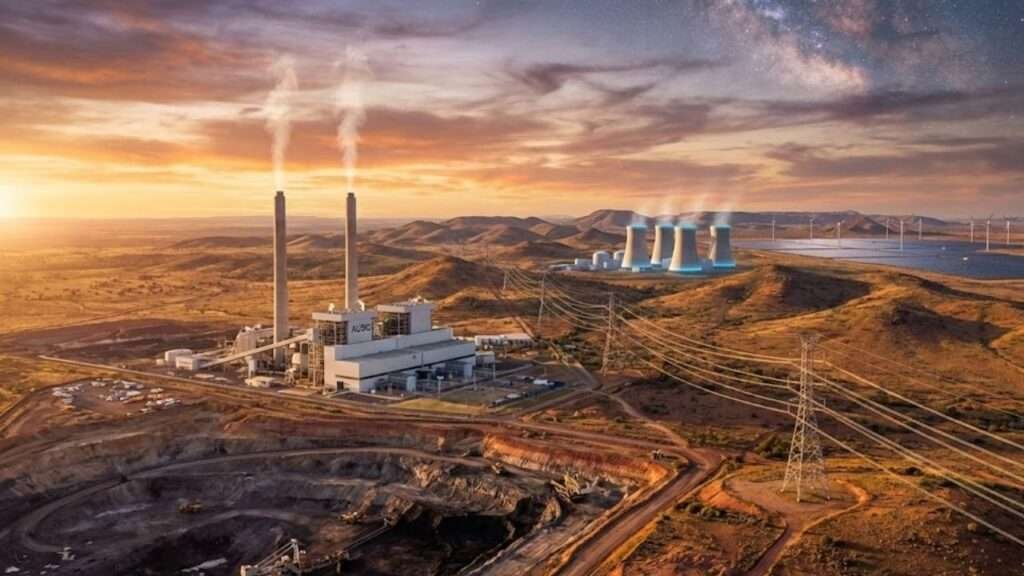
Building 10 brand new 3 to 4
GW Advanced Ultra‑Supercritical (AUSC) / HELE coal‑fired power stations,
each comprising 3 to 4 high‑efficiency units, would give Australia a stable,
affordable and strategically reliable energy backbone during the 10 to 15 years
required for nuclear power to scale.
These plants act as a
pragmatic transition technology, supporting the grid, protecting industry and
buying time for long‑term zero‑emission options to mature.
12.1.
Reliability Boost.
AUSC plants operate at 85%+ availability, delivering true
baseload power that far outperforms Australia’s aging subcritical fleet or
intermittent renewables without large‑scale storage.
With the existing coal
fleet suffering 128 breakdowns in a
single summer and units such as Gladstone running at 50% downtime, the construction of 10
x 3 to 4 GW AUSC stations (30–40 GW
total) would:
1.
Replace retiring coal
capacity before 2035.
2.
Add new firming capacity
to support population and industrial growth.
3.
Reduce AEMO interventions
that push wholesale prices higher.
Modern AUSC units can also
ramp quickly, enabling
smoother integration with solar and wind.
This flexibility becomes
essential as AEMO’s 2024 ISP anticipates 90%
of coal capacity retiring by the mid‑2030s, requiring a
fourfold increase in firming resources.
12.2.
Cost Stabilisation.
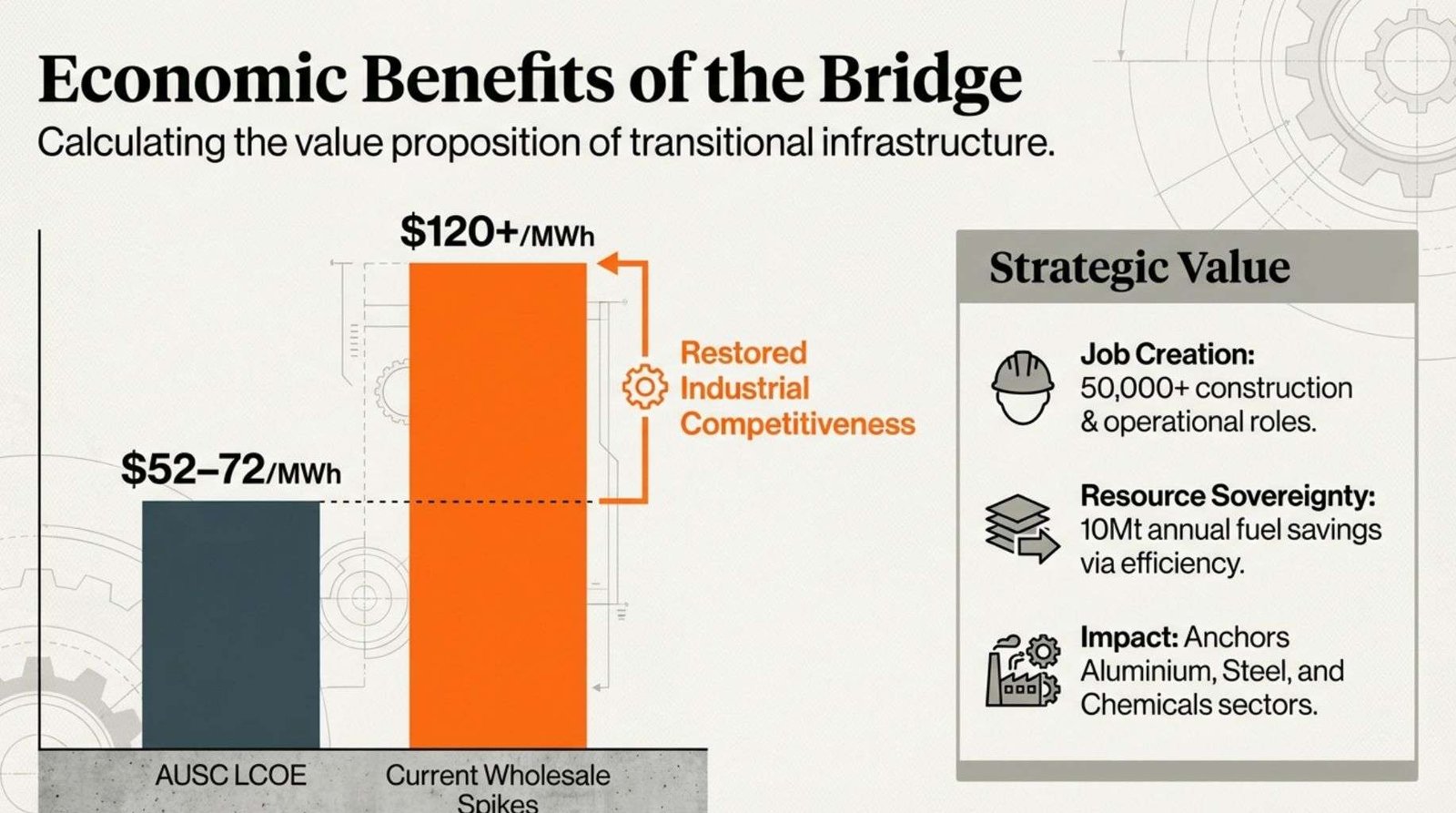
The LCOE of AUSC generation ($52–72/MWh)
is well below recent wholesale price spikes above $120/MWh. For energy‑intensive
industries, metals, chemicals, cement, fertilisers, this stability is critical,
especially after 27% real electricity
price increases since 2023 and more than 25,000 insolvencies linked to rising
operating costs.
Higher thermal efficiency
(up to 47.5%, compared
with 30–35% for legacy units) reduces coal consumption by roughly 1 Mt per GW per year. Across ten 3–4
GW plants, this equates to 30–40 Mt of
annual fuel savings, strengthening energy security by relying
on domestic reserves rather than imports.
12.3.
Emissions Reductions.
AUSC technology reduces
emissions intensity by 30–40%,
from around 986 kg/MWh
(subcritical) to ~674 kg/MWh.
Across 30–40 GW operating at 85%
capacity factor, this represents:
·
~70–95 Mt
CO₂ avoided annually, depending on final
capacity
·
Major reductions in NOx,
SOx, particulates and mercury
·
Lower health‑related
externalities, which legacy plants currently impose at an estimated $2.4B per year
Designing these stations
as CCS‑ready future‑proofs
them for carbon pricing and extends their operational relevance over the 40–50
year horizon while nuclear capacity ramps up.
12.4.
Industrial and Economic Gains.
|
Benefit |
Impact of 10 AUSC Plants (30–40 GW Total) |
|
Jobs |
50,000+ construction and operations roles;
preserves skilled labour for future nuclear deployment. |
|
Regional Development |
Revitalises Hunter Valley, Bowen Basin and
other coal regions by reusing existing grid, rail and port infrastructure. |
|
Industry Support |
Provides firm, affordable power for
aluminium, steel, data centres and critical minerals processing, helping
arrest manufacturing decline (now ~5% of GDP). |
|
Export Alignment |
Supports the $50B coal export sector and
its ~350,000 indirect jobs by maintaining domestic demand and skills
continuity. |
Locating new AUSC plants
at retiring coal sites, such as those in north Queensland, minimises
transmission upgrades and enables orderly phase‑out of inefficient units.
12.5.
Strategic Bridge to Nuclear.
Under the proposed
ANSTO–ARPANSA–CSIRO framework, Australia’s first nuclear output could
potentially be expected around
2038–2040 (with a bit of luck most likely also required)
AUSC plants provide the
firm thermal generation required to bridge this gap without immediate regulatory overhaul.
AEMO modelling indicates
that firm thermal capacity remains essential to 2040,
regardless of renewable penetration. Without it, Australia risks:
1.
Overbuilding renewables
and storage by 50–120%
to achieve equivalent reliability.
2.
Accelerating industrial
decline due to volatile energy prices.
3.
Increasing reliance on gas
peakers and imports.
AUSC therefore stabilises
the system while governments progress nuclear legislation (ARPANS Act
amendments, EPBC considerations) and negotiate state‑level approvals.
12.6.
Risks and Mitigations.
1.
Capital
Cost: AUSC requires $2–3B per GW, but competitive LCOE
and long asset life offset upfront investment. Government guarantees or
capacity mechanisms can de‑risk financing.
2.
Public
Perception: Opposition often stems
from legacy coal plants. Positioning AUSC as modern, high‑efficiency, 40% cleaner transitional infrastructure
reframes the narrative.
3.
Build
Time: AUSC plants can be delivered in 5–7 years, significantly faster than
nuclear’s 10–15 year timeline, enabling rapid reinforcement of the grid.
Summary.
10 x 3 to 4 GW AUSC/HELE
power stations would:
1.
Restore grid stability.
2.
Provide affordable
electricity for industry.
3.
Reduce emissions and coal
consumption.
4.
Support regional economies
and skilled workforces.
5.
Create a reliable bridge
to nuclear power.
This approach prevents
further de‑industrialisation and ensures Australia maintains energy security
while transitioning to long‑term zero‑emission technologies.
13. Balance: Industry,
Environment, Prosperity & The Cost of Living.
This article has tried to outline
a practical 15‑year pathway for Australia’s energy future, one shaped by
realism rather than rigid ideology.
It reflects the author’s
considered view that a sequenced transition can protect jobs, steady household
bills, reduce emissions and support a stronger industrial base. It isn’t
presented as a flawless blueprint; every energy strategy faces uncertainties,
from global supply chains to shifting policy settings.
Even so, the underlying
logic aims to speak to a broad set of interests: reliable power for industry,
meaningful decarbonisation for the environment, more predictable costs for
households and greater economic confidence for the nation.
The approach begins by
acknowledging the pressures facing Australian industry.
Many sectors require
dependable, around‑the‑clock energy to remain competitive and recent business
closures highlight the consequences when that stability falters. In this model,
advanced coal and gas technologies act as a transitional bridge through to
2040, offering firm supply while new systems scale up.
Environmental outcomes
also improve early in the transition. More efficient thermal generation reduces
emissions compared with older plants, while expanded firming capacity, consistent
with AEMO’s planning outlook, supports a higher share of renewables over time.
Beyond that horizon,
nuclear energy is positioned as a potential long‑term source of zero‑emission
baseload, drawing on international examples where it has delivered stable, low‑carbon
supply.
Prosperity is another
pillar. A managed transition helps retain specialised skills across
construction, operations and export‑linked industries, supporting regional
communities that have long contributed to Australia’s energy economy.
It also creates space for
emerging sectors, such as hydrogen, advanced manufacturing and defence, to grow
from a more stable energy foundation.
Finally, the cost‑of‑living
dimension is central. More predictable wholesale prices reduce the risk of
sharp spikes and help shield families from ongoing bill increases. Stable
energy costs underpin broader affordability and give households confidence to
plan beyond immediate utility pressures.
Taken together, this
balanced mix, transitional thermal generation, expanding renewables and a long‑term
nuclear option, aims to keep all stakeholders engaged in the journey.
The alternative is
continued uncertainty; the opportunity is a more resilient, more prosperous
Australia over the next 15 years (one can only hope).
14. Conclusion: Choose
Building Over Decline.
Australia’s industrial
recovery depends on its willingness to face energy reality.
Cheap, round-the-clock
electricity is not optional; it is the foundation of modern sovereignty.
Without it, manufacturing, defence capability and advanced exports will
diminish.
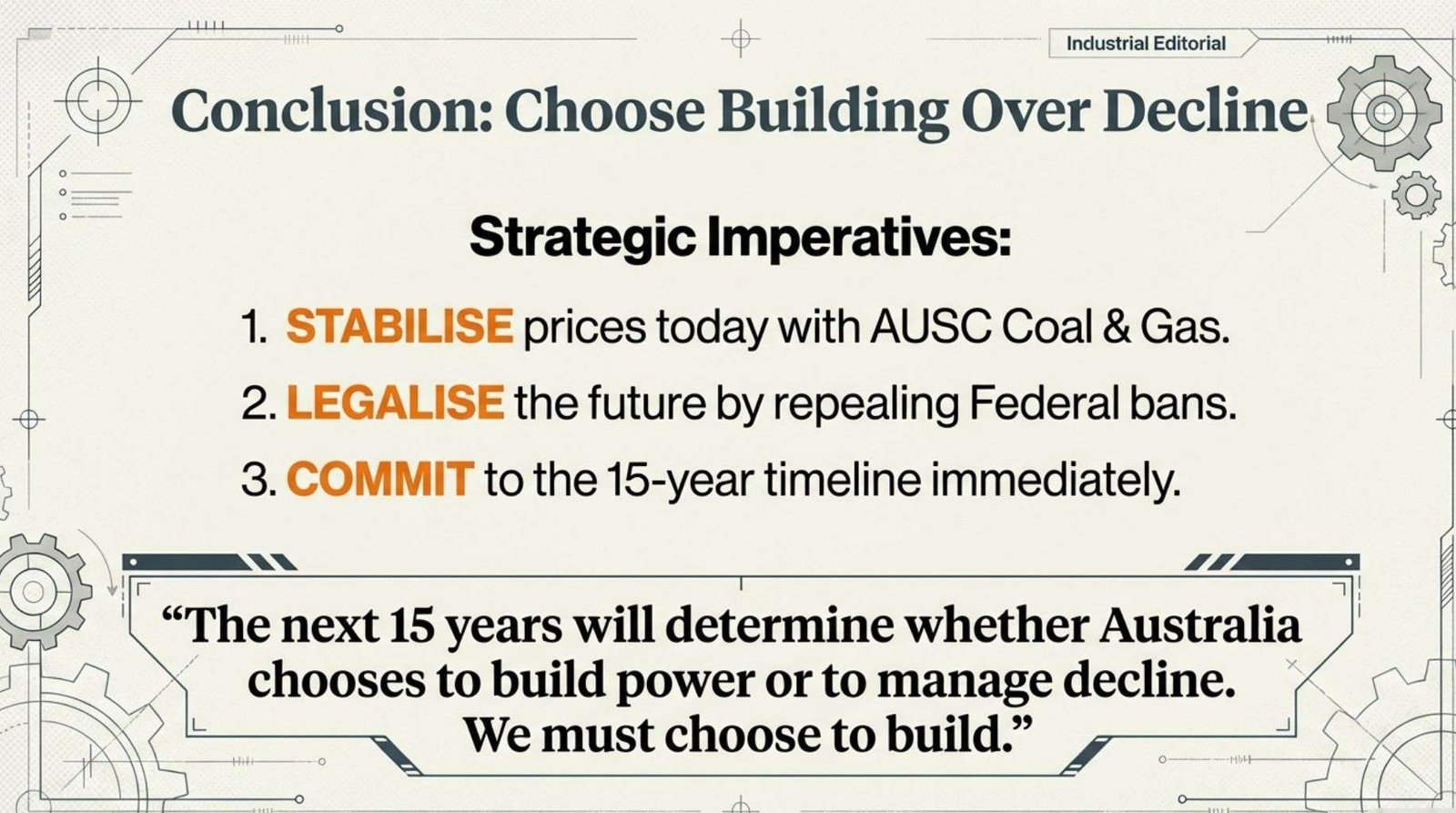
The strategic path is
clear:
1.
Stabilise prices today
using efficient coal, gas and hydro where viable.
2.
Rebuild the institutional
and legal architecture for nuclear energy.
3.
Commit to an integrated,
long-term energy strategy where renewables and nuclear coexist to restore
national strength.
Every year of delay adds
years to recovery. The next 15 years will determine whether Australia chooses
to build power or to manage decline. With vision, pragmatism and institutional
focus, this energy transition can restore Australia’s place among the world’s
advanced industrial economies.
15. Bibliography.
1.
Australia’s Energy Transition: Policy and Regulation
Australian Energy Market Operator (AEMO), 2024.
2.
GenCost 2024-25: Electricity Generation Costs Update
CSIRO, 2025.
3.
Nuclear Power in Australia: Legal and Regulatory Barriers
Australian Radiation Protection and Nuclear Safety Agency (ARPANSA), 2024.
4.
Coal Fleet Transition: Australia’s Power System to 2040
Department of Climate Change, Energy, the Environment and Water, 2024.
5.
Firming the Grid: Storage and Dispatchable Power Needs
Australian Energy Market Operator (AEMO), 2025.
6.
AUSC Coal Technology: Efficiency and Emissions
International Energy Agency (IEA), 2023.
7.
Manufacturing
Decline: Australia’s Industrial GDP Share
Australian Bureau of Statistics (ABS), 2025.
8.
Business Insolvencies 2023-2025: ASIC Data
Australian Securities and Investments Commission (ASIC), 2025.
9.
EPBC
Act and Nuclear Prohibitions
Department of Climate Change, Energy, the Environment and Water, 2024.
10.
ARPANS
Act 1998: Nuclear Safety Framework
Australian Government, 2024.
11.
ANSTO
Nuclear Capabilities Report
Australian Nuclear Science and Technology Organisation (ANSTO), 2025.
12.
Global
Nuclear Newcomer Timelines: Poland and Czech Republic
International Energy Agency (IEA), 2024.
13.
HELE Coal Retrofit Opportunities in Australia
Clean Energy Finance Corporation, 2023.
14.
AEMO Wholesale Electricity Market Report 2023-2025
Australian Energy Market Operator (AEMO), 2025.
15.
Industrial
Electricity Prices: International Comparison
International Energy Agency (IEA), 2025.
16.
Our
Plan for Zero-Emissions Nuclear Energy[australianeedsnuclear.org]
Australian Needs Nuclear, 2024.
17.
Australia’s Energy Transition: Policy Stocktake[researchers.mq.edu]
Macquarie University Researchers, 2025.
18.
Coal Gone by 2034: AEMO 2024 ISP[unsw.edu]
University of New South Wales, 2023.
19.
Will Australia Require Nuclear Energy?[studentorgs.kentlaw.iit]
Hemming, J., 2025.
20.
Nuclear Pathway Impact Assessment[climatechangeauthority.gov]
Climate Change Authority, 2025.
21.
Nuclear Power Inquiry Submission[climatecouncil.org]
Climate Council, 2025.
22.
Australia 2023 Energy Policy Review[iea.blob.core.windows]
International Energy Agency (IEA), 2023.
23.
Clean Energy Australia Report 2025[cleanenergycouncil.org]
Clean Energy Council, 2025.
24.
Coalition Nuclear Power Plan Explained[thedailyaus.com]
The Daily Aus, 2025.
25.
AEMO 2024 Integrated System Plan Full Report[australianphotography]
Australian Energy Market Operator (AEMO), 2024.
26.
CSIRO
GenCost Nuclear Analysis[capturemag.com]
CSIRO, 2025.
27.
ASIC Insolvency Statistics Mid-2023 to 2025[davidmagro]
Australian Securities and Investments Commission (ASIC), 2025.
28.
Manufacturing
GDP Share Record Low 2025[jaydidphoto]
Australian Bureau of Statistics (ABS), 2025.
29.
Nuclear Legislation Reforms Needed[camblakephotography.com]
Australian Parliament, 2025.
30. Global AUSC Coal Deployments[adventureartphotography.com]
World Coal Association, 2024.